Powering Africa's Industrial Future: Skills for Innovation, Growth, and Sustainability.
Africa's youth, comprising the world's largest and fastest-growing youth population, are being empowered to gain skills for economic transformation through initiatives focused on foundational education, vocational training, and digital literacy. Key areas of skill development include STEM, cybersecurity, entrepreneurship, analytical thinking, and sustainability. To address the skills gap, organizations and governments are reforming educational curricula, providing teacher training, and fostering connections between education and the job market.

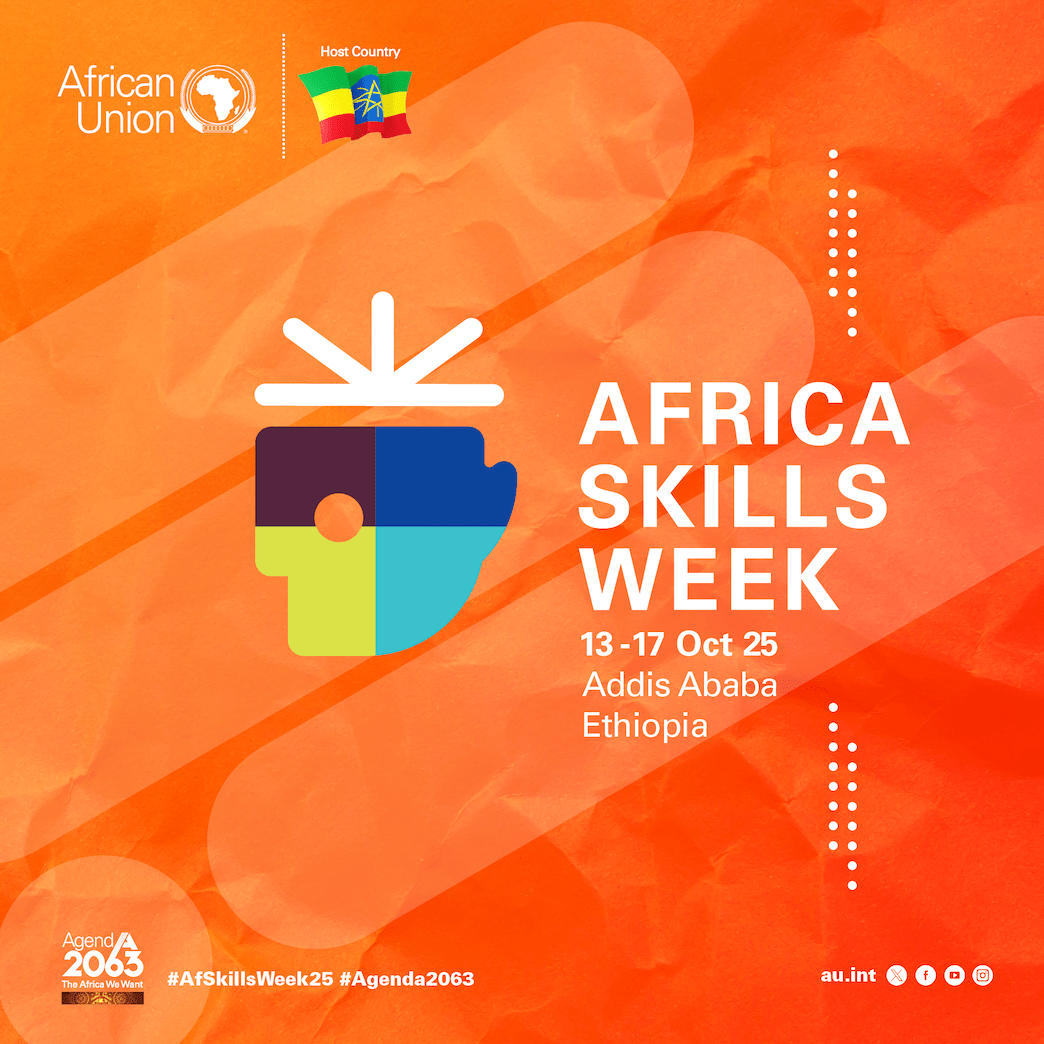
Theme: “Powering Africa's Industrial Future: Skills for Innovation, Growth, and Sustainability”
13-17 October 2025 | African Union Headquarters, Addis Ababa, Ethiopia
About Africa Skills Week 2025
Africa Skills Week (ASW) is a continental platform dedicated to advancing Africa’s skills transformation agenda. Building on the success of ASW 2024, the second edition will unite policymakers, industry leaders, educators, youth, and development partners to drive actionable solutions for skills development aligned with industrialization, sustainability, and the African Continental Free Trade Area (AfCFTA).
Hosted by the African Union Commission, through its Department of Education, Science, Technology and Innovation (ESTI), in collaboration with the Government of the Federal Democratic Republic of Ethiopia - Ministry of Labour and Skills.
ASW 2025 will focus on:
- Strengthening skills for industrial growth and innovation.
- Enhancing inclusive, quality Technical and Vocational Education and Training (TVET).
- Fostering public-private partnerships and regional collaboration.
- Leveraging digital and green technologies for workforce readiness
Key Themes
ASW 2025 will address the following thematic areas, amongst others:
Policy, Governance and Finance for Skills and Industrialization
Examining how coherent policy frameworks, governance reforms, financing mechanisms, and cross-sectoral coordination can drive skills development for Africa’s industrial growth, productivity, job creation, and economic transformation. This pillar will also spotlight regional cooperation and the operationalization of AfCFTA through skills mobility and policy coherence.
Quality and Inclusion in Skills Development
Addressing how skills intelligence, demand-driven curricula, and lifelong learning systems can foster high-quality, inclusive TVET responsive to labour market needs. This includes integrating climate-smart, green, and digital skills, promoting gender equality in STEM, supporting vulnerable groups (youth, women, migrants, people with disabilities), and bridging rural–urban disparities in access to training.
Partnerships, Knowledge and Resource Sharing for Industrial Competitiveness
Fostering stronger partnerships between TVET systems and the productive sector, including MSMEs, to enhance relevance and innovation in training. This pillar will explore co-creation of programmes, regional centres of excellence, mutual recognition of skills, South-South cooperation, and cross-border peer learning as mechanisms for building a dynamic, integrated African skills ecosystem.
Institutional Development, Technology and Innovation
Exploring how institutional capacity, digitalization, research, and innovation ecosystems can transform Africa’s skills landscape and industrial competitiveness. This includes building the capacity of TVET institutions and trainers, promoting entrepreneurship and incubation hubs, and driving digital and green transitions in TVET systems and industrial value chains.
Inclusive Skills Development for Refugees and Forcibly Displaced Persons
Consistent with the Continental TVET Strategy 2025–2034, Africa Skills Week 2025 will address the inclusion of refugees and other forcibly displaced persons in skills systems that support industrial growth, innovation, and sustainability. Ethiopia, as host country, has taken concrete steps in this area through its pledge to provide formal TVET opportunities for 20,000 refugees and host community members. Integrating displaced populations into skills development and employment pathways is an important dimension of building a skilled, inclusive workforce and advancing the objectives of Agenda 2063.
Event Highlights
The Skills Week 2025 will feature a combination of high-level dialogue, technical sessions, exhibitions, and stakeholder-driven platforms aimed at catalysing action on industrial skills development.
Key activities will include:
High-Level Plenaries
Opening Ceremony: Keynote addresses by African Union leaders, Head of State, and development partners, emphasizing the provisions of the CTVET Strategy and its alignment with Agenda 2063 and the commitments to Africa’s Skills for Industrialization.
Ministerial and Private Sector Roundtable
A high-level dialogue between Ministers responsible for education, labour, and industry, alongside CEOs and business leaders, to shape policy directions and investment priorities for skills development aligned with priority value chains.
Technical Sessions and Sectoral Panels
A series of thematic sessions led by experts, showcasing best practices and innovations in skills development across industrial priority sectors. These panels will include voices from industry, academia, and civil society.
Skills Development Marketplace and Exhibition
A showcase of institutions, innovations, and partnerships contributing to skills development across Africa. This space will provide visibility for national and regional programmes, private sector-led initiatives, and youth-led innovations.
Youth and Entrepreneurial Engagement Platform
Designed to elevate the voices of young people, women, and emerging entrepreneurs, this platform will feature career dialogues, innovation pitches, and networking spaces that foster mentorship and opportunity.
CTVET Strategy Implementation Forum:
A multi-stakeholder session convened by the AUC, AUDA-NEPAD and partners to share country progress, innovations, and implementation pathways of the CTVET Strategy. It will facilitate technical collaboration, peer learning, and policy alignment across Member States and RECs. The forum will also be a platform to validate the draft CTVET Strategy Implementation Plan.
Field Visits
Africa Skills Week 2025 will feature curated field visits to selected industrial parks, TVET institutions, innovation hubs, and enterprise training centres in Ethiopia to reinforce the CTVET Strategy’s emphasis on enterprise-based learning and stronger linkages between training systems and industry needs. These visits will demonstrate practical models of skills development, enterprise partnerships, and innovation ecosystems in action. They will also offer participants direct exposure to public-private partnerships in dual training, apprenticeships and practical application of digital and green technologies in training and production.
Country-Level Action to commemorate the Week:
These will be skills development and employment-focused actions in the Member States to celebrate the week. Member States will be encouraged to use Africa Skills Week as a springboard for national action plans aligned with the CTVET Strategy 2025–2034. AUC and AUDA-NEPAD will support coordination, visibility, and peer learning across countries to deepen ownership and impact. The African Union Development Agency (AUDA-NEPAD) and African Union Commission will map country-level actions, and the Member States are encouraged to share details of country-focused events for the week.
Closing and Commitment Session
A synthesis session where key outcomes, recommendations, and stakeholder commitments will be captured in a communique for action and follow-up.
Key Themes; Event Highlights; Expected Outcome and Resources.
Follow the Conversation with the hashtags : #AfSkillsWeek25, #Agenda2063
High-Level Plenaries
Opening Ceremony: Keynote addresses by African Union leaders, Head of State, and development partners, emphasizing the provisions of the CTVET Strategy and its alignment with Agenda 2063 and the commitments to Africa’s Skills for Industrialization.
Ministerial and Private Sector Roundtable
A high-level dialogue between Ministers responsible for education, labour, and industry, alongside CEOs and business leaders, to shape policy directions and investment priorities for skills development aligned with priority value chains.
Technical Sessions and Sectoral Panels
A series of thematic sessions led by experts, showcasing best practices and innovations in skills development across industrial priority sectors. These panels will include voices from industry, academia, and civil society.
Skills Development Marketplace and Exhibition
A showcase of institutions, innovations, and partnerships contributing to skills development across Africa. This space will provide visibility for national and regional programmes, private sector-led initiatives, and youth-led innovations.
Youth and Entrepreneurial Engagement Platform
Designed to elevate the voices of young people, women, and emerging entrepreneurs, this platform will feature career dialogues, innovation pitches, and networking spaces that foster mentorship and opportunity.
CTVET Strategy Implementation Forum:
A multi-stakeholder session convened by the AUC, AUDA-NEPAD and partners to share country progress, innovations, and implementation pathways of the CTVET Strategy. It will facilitate technical collaboration, peer learning, and policy alignment across Member States and RECs. The forum will also be a platform to validate the draft CTVET Strategy Implementation Plan.
Field Visits
Africa Skills Week 2025 will feature curated field visits to selected industrial parks, TVET institutions, innovation hubs, and enterprise training centres in Ethiopia to reinforce the CTVET Strategy’s emphasis on enterprise-based learning and stronger linkages between training systems and industry needs. These visits will demonstrate practical models of skills development, enterprise partnerships, and innovation ecosystems in action. They will also offer participants direct exposure to public-private partnerships in dual training, apprenticeships and practical application of digital and green technologies in training and production.
Country-Level Action to commemorate the Week:
These will be skills development and employment-focused actions in the Member States to celebrate the week. Member States will be encouraged to use Africa Skills Week as a springboard for national action plans aligned with the CTVET Strategy 2025–2034. AUC and AUDA-NEPAD will support coordination, visibility, and peer learning across countries to deepen ownership and impact. The African Union Development Agency (AUDA-NEPAD) and African Union Commission will map country-level actions, and the Member States are encouraged to share details of country-focused events for the week.
Closing and Commitment Session
A synthesis session where key outcomes, recommendations, and stakeholder commitments will be captured in a communique for action and follow-up.
Key Themes; Event Highlights; Expected Outcome and Resources.
Follow the Conversation with the hashtags : #AfSkillsWeek25, #Agenda2063
Register to participate to the 2nd Africa Skills Week!


Comments
Post a Comment